


THE BEIT HAMIKDASH – Overview
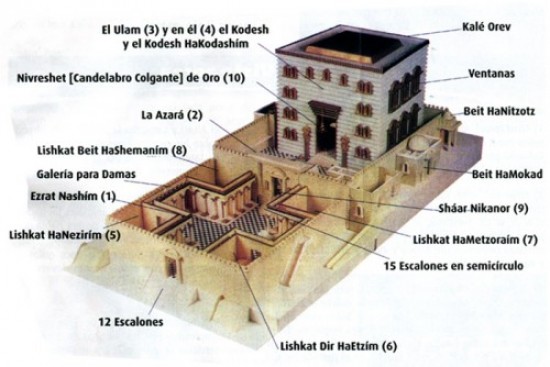
The Beit HaMikdash -Great Temple- is divided into four general sectors: A: Ezrat Nashim [Ladies' Section] (1), is the Outer Courtyard, where in the Festival of Sukkot a gallery was erected for the ladies. B: The Azará [Atrium] (2) where the offerings were brought. C: He Ulam (3), the largest building of the Beit HaMikdash, with a height of 100 amot Cudos [1 'cudo' = 48cm.], about 17 floors!) D: He Kodesh [Holy] and the Kodesh HaKodashim [Holy of Holies] (4), where the most sacred objects were located.
EZRAT NASHÍM
The Ezrat Nashim was an area of 135 x 135 cubits. In its four corners were chambers, each 40 x 40 cubits. The southeast chamber (5) was called Lishkat HaNezirim [Chamber of the Nazarenes]; in it, they cooked their offerings and cut their hair after completing their Nazirite vows. In the northeast corner (6) was the Lishkat Dir HaEtzimim [Storage Chamber of the Wood], where priests with physical disabilities (and therefore unfit to offer sacrifices) checked that the wood for the altar was free of worms.
In the northwest corner (7) the Metzoraim made their immersions, in order to bring their offering.
In the southwest chamber (8) were stored the wine and oil required for the tasks of the Great Temple, hence its name.- Lishkat Beit HaShemanim [Chamber-depot of the Oils].
CHANCE
The sanctity of the Azara is superior to that of the Ezrat Nashim, for it was there that sacrifices were offered. The area of the Azara (187 x 135 cubits) was surrounded by walls, with seven gates. Each of these measured 20 cubits wide and 10 cubits high. On the north side these were: Shaar HaNitzotz, Shaar Ha-Korban, and Shaar Beit HaMokad; on the east: Shaar Nikanor; on the south: Shaar HaDelek, Shaar HoBejorot, and Shaar HaMaim.
In the Azara the sacrifices were offered: there they were slaughtered, their blood was sprinkled on the Altar, they were skinned, they were cut up, and their parts were offered on the Mizbeaj Hachitzon [Outer Altar].
THE ULAM
Twelve steps led to the entrance of the Ulam. Its door had no leaves, but only a curtain (Parojet). The building was wider at the front than at the back; this gave it the shape of a lion's body, so it was called Ariel.
In the center of the Ulam stood the Kodesh and the Kodesh HaKodashim. Around them were built a series of booths (ta'im), through which one could also reach the roof of the Kodesh and the Kodesh HaKodashim for maintenance, once every seven years. Along the edges of the Ulam's roof was a fence of sharpened metal spears, three cubits high, to prevent crows and other birds from perching on the edges and soiling the walls of the Ulam. This fence was called Kalé Orev.
THE KODESH AND THE KODESH HAKODASHÍM
In the center of the Ulam were housed the Kodesh and the Kodesh HaKodashim, with an additional entrance in front of them. In the Kodesh were: the Menorah [Candelabrum], the Shulchan HaZahav [Golden Table], and the Mizbeaj HaZahav [Golden Altar].
In the Holy of Holies stood the Even HaShti'ah, and upon it, in the First Great Temple, stood the Holy Ark. The High Priest entered this place once a year, on Yom Kippur.
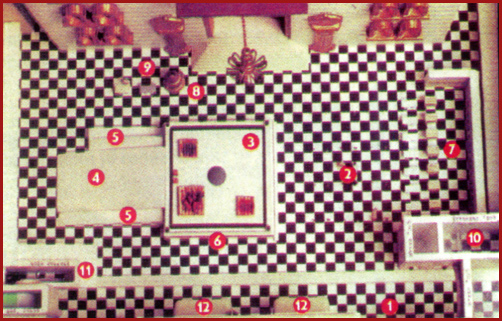
1) Ezrat Israel. The area within the Temple Mount (Azareh) where Jewish men of Israel entered in a state of ritual purity. It was separated from the Temple Mount (Ezrat Kohanim) by four steps, upon which the Levites stood and sang during the sacrificial offering.
2) Ezrat Kohanim. There, the tasks related to the offerings were performed: the animals were slaughtered, their blood was sprinkled on the altar, they were skinned, cut into pieces, and their parts were burned on the altar. Grain offerings (of flour and wine) and the pouring of wine and water on the altar also took place there.
3) The Mizbeaj Hachitzon. A red rope (chut HaSikra) encircled the Altar, marking off areas for the different blood offerings. On the roof of the Altar were four pillars (kronot) and three fires. In the center of the Altar was the Topuaj, a pile of ashes collected from the burning wood. On the south side of the Altar (4) was the main Kebesh (Ramp), and on either side (5) were two additional small ramps. The Priest ascended the small ramp on the right to the Sovev (6) (a kind of step encircling the Altar) and sprinkled the blood of the offering on the four pillars of the Altar. Having completed his task, he descended the small ramp on the left.
7) Beit HaMitbajaim. Eight posts with hooks for hanging the slaughtered animals and skinning them. Next to the posts were eight marble tables for butchering them.
8) The Kior. A basin with twelve taps. It was used by the priests to wash their hands and feet before beginning their priestly service.
9) Shuljanot. Two tables, one silver and one marble, used by the priests during their service. The silver one was for holding the vessels, and the marble one for holding the pieces of the offerings.
10) In the Azará there were nine Chambers. To the north (10): Lishkat HaGazit (where the 71 members of the Great Sanhedrin met), Lishkat Parhedrin (residence of the High Priest), Lishkat HaGolá (from which water was supplied to the entire Azara). To the south (11): Lishkat HaMelaj (salt deposit for Azara), Lishkat HaParva (that's where the hides of the sacrifices were salted), Lishkat HaMadijín (The entrails of the sacrifices were washed there.) To the east (12): Lishkat Pinchas HaMalbish (headquarters of the person in charge of priestly vestments), Lishkat Osei Javitín (There the High Priest's daily offering was baked.) In Ezrat HaKohanim there was an additional chamber, called Lishkat Beit Avtinas, where the incense was prepared.
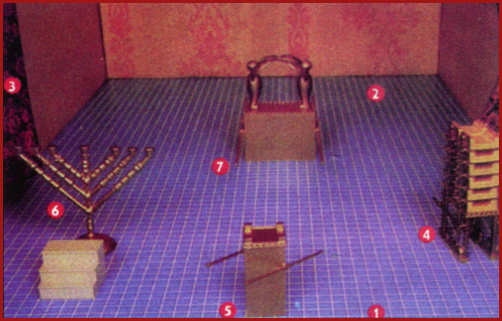
1. Kodesh. The outer sector is the Kodesh, where the Menorah [Candelabrum] (6), the Ark (7) and the Shulchon HoPonim (4) were located.
2. Kodesh HaKodashim. The innermost and most sacred sector. The High Priest entered there once a year, on Yom Kippur.
3. A Parojet (Curtain), separated the Kodesh from the Kodesh HaKodashim (in the image, the curtain (3) is open).
4. Shulchan HaPanim. It was on the north side of the Kodesh, made of acacia wood overlaid with gold. The 12 Lechem HaPanim (Bread of the Presence) and the Levonah were placed on it, and it had two Badim (carrying poles) on its sides.
5.Mizbeaj HaZahav (Golden Altar)It stood in the center of the Kodesh, slightly to the east. Incense was offered on it, and on its sides it had two poles for carrying it.
6. Menorah (Candelabrum). Made of gold, with seven arms. It stood to the south of the Kodesh. Its arms were diagonal.
7. The Ark of the Covenant. Made of acacia wood and overlaid with gold, it stood within the Holy of Holies. It had altars on its sides, and above it were two cherubim. It was not in the Second Temple; only the Temple of the Holy Spirit remained. When the High Priest entered this chamber, he was to visualize the appearance of the Ark.
Extracted from www.jabad.org.ar